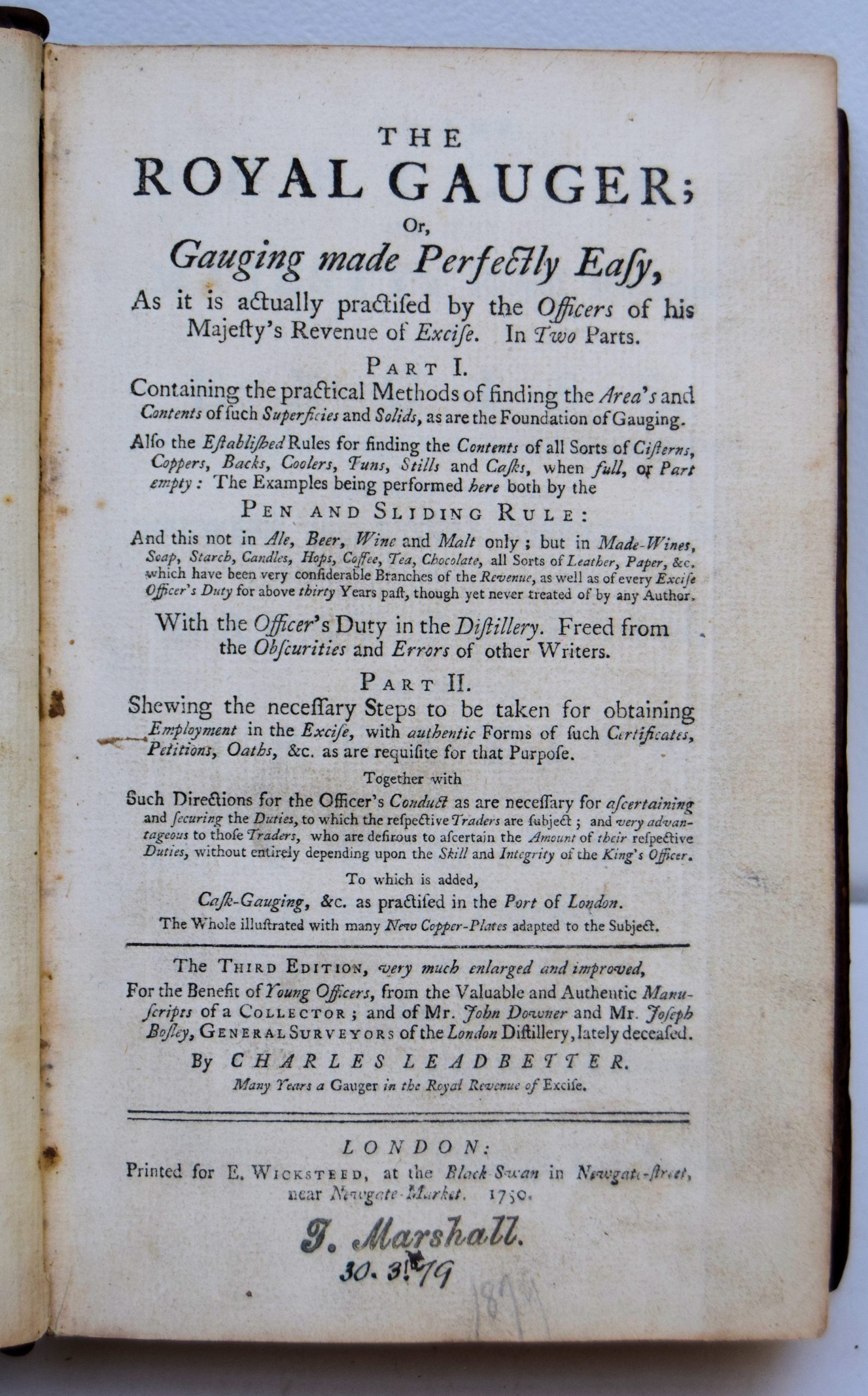
The Royal Gauger; Or, Gauging Made Perfectly Easy,.
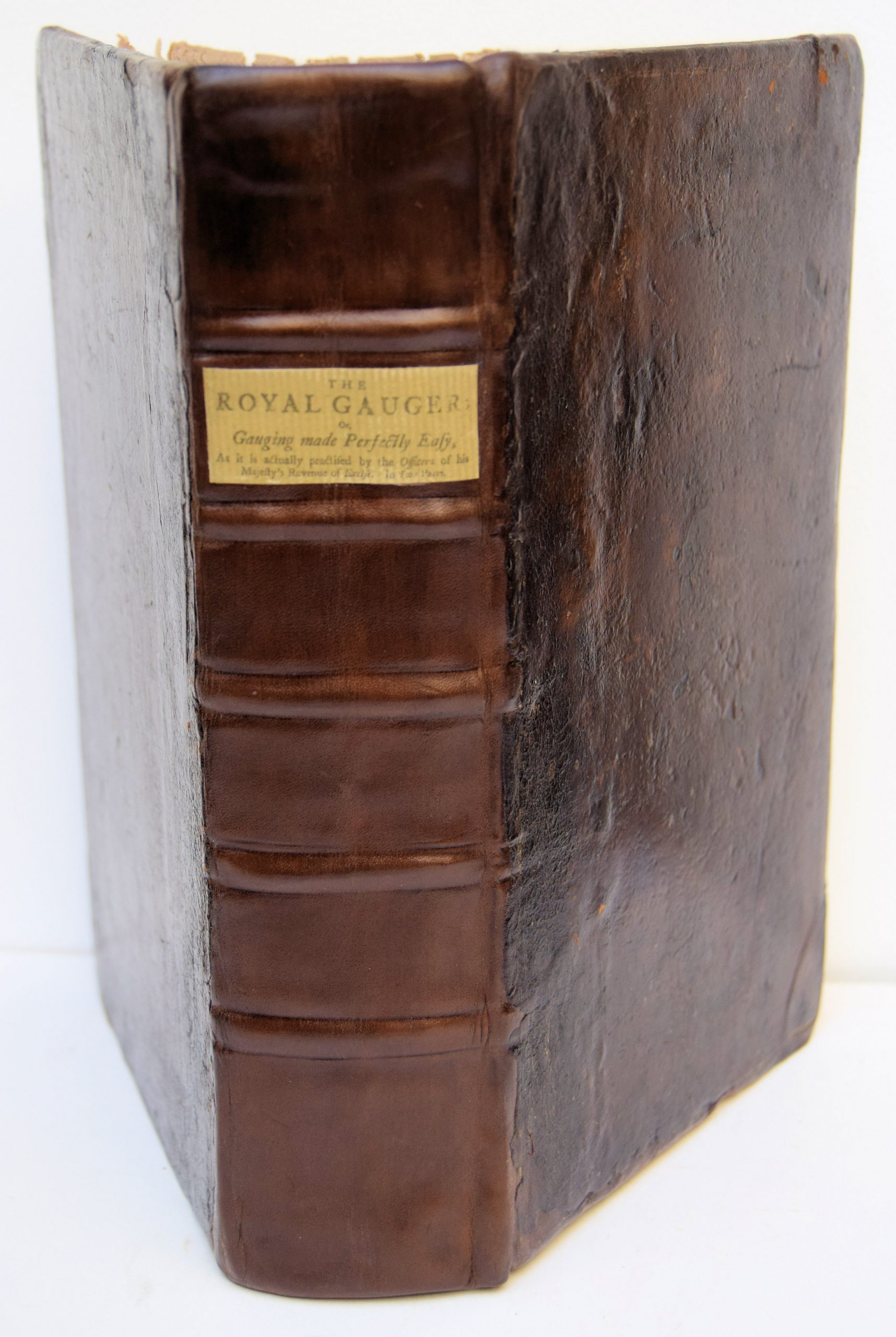
Bound in original full calf with gilt borders; spine rebacked, in compartments with recent paper label. A very good example with ownership inscriptions of Richard Lisle, Exeter, 1829 and Marshall, Carlisle, 1879. Stamp of T. Marshall and ink date 1879 at foot of title page and at end.
£650.00
Publisher
Printed for E. Wicksteed, at the Black-Swan, in Newgate-street, Near Newgate-Market.,
Place
London
Date
1750
Synopsis
As it is actually practised by the officers of his majesty's revenue of excise. in two parts.
part i. containing the practical methods of finding the area's (sic) and contents of such superficies and solids as are the foundation of gauging. also the established rules for finding the contents of all sorts of cisterns, coppers, backs, coolers, tuns, stills and casks, when full, or part empty: the examples being performed here both by the pen and sliding rule : and this not in ale, beer, wine, and malt only; but in made-wines, soap, starch, candles, hops, coffee, tea, chocolate, all sorts of leather, paper, etc., which have been very considerable branches of the revenue, as well as of every excise officer's duty....
part ii. shewing the necessary steps to be taken for obtaining employment in the excise, with authentic forms of such certificates, petitions, oaths, etc. as are requisite for that purpose. together with such directions for the officer's conduct as are necessary for ascertaining and securing the duties, to which the respective traders are subject; and very advantageous to those traders, who are desirous to ascertain the amount of their respective duties, without entirely depending upon the skill and integrity of the king's officer. to which is added, cask-gauging, etc. as practised in the port of london. the whole illustrated with many new copper-plates adapted to the subject.
the third edition, very much enlarged and improved...
Item Description
8vo. 5.5 x 8.5 inches. xviii + [ii] (specimen form and errata slip tipped in) + 509 pp. + [1] pp. publisher's advertisement.
Illustrations
Illustrated by a folding hand-coloured frontispiece and 6 large folding copperplate engravings one of which is hand-coloured and by two folding tables. Decorated by endpiece vignettes.
Notes
A significant work on the practical application of mathematics, which pioneered the use of the slide rule for excise purpose. Illustrated with beautifully drawn folding plates, Part I of the book contains detailed mathematical information, including tables, calculations and formulae. Part II deals with how to become employed by the Excise, the duties of the officer and the conduct necessary to remain in employment.
Charles Leadbetter (1681-1744) served with The Excise and became a well-known teacher and writer on mathematics and astronomy. It is an expanded sequel to an earlier work of 1684 'and rapidly became the best guide to the practice of gauging for the levying of excise duty across the broad spectrum of trades subject to tax' (DNB). A scarce and important book, which sets out in minute detail the methods and duties of the eighteenth century excise officer.
[Stock No. 23759]

Subjects
18th Century • Excise • Kent • Mathematics • Smuggling